Monday, July 21, 2014

P.G Wodehouse fan rave

I'm having a P.G. Wodehouse (is it pronounced Woodhouse or Woadhouse?) thing at the moment. This has been driven by:

  • finding the whole set of Wodehouse Playhouse with the divine John Alderton and the stunning Pauline Collins on it. I love them. Love them. If you like the frocks on Downton Abbey and Miss Fisher Investigates but also like extreme silliness, I recommend them to you as well. If you can find them. see below for a sample. Failing that, read his novels.
  • I read Sebastian Faulks' homage, Jeeves and the Wedding Bells, which struck just the right note I felt. Given Wodehouse is dead (sob! Ok he lasted til about 93, but still!), there's licence for him to do some tying up, which he does. And it's funny and respectful, and it made me get out 3 of the novels from the library
  • Of them I have finished Joy in the morning, which is one of the best Jeeves and Wooster novels
  • I have a feeling I may be hunting down the Fry and Laurie Jeeves and Wooster series next. 
I am taking a break before I read more Wodehouse though - I'm reading The Man without a face, by Masha Gessen. It's a biography of Vladimir Putin, which is topical of course. But even 50 pages in, the depiction of the grimness and corruption of post-Soviet life will make Wodehouse's light-hearted froth as welcome as a warm fire on a wet day. 

Friday, July 11, 2014

Quitting dieting

I got an enormous amount out of the city library today - 11 items, but this post is just about two of them.
They are Health at every size, by Linda Bacon, and The emotional eater's repair manual, by Julie Simon. These are related to the decision I made a few weeks ago that I was going to give up trying to lose weight. Which is, to be honest, a decision that is proving problematic. I have no idea if I've gained or lost weight, I have no idea if my balance of 'healthy' days to 'over-eating' days is worse or better than it was - because I'm no longer weighing myself or monitoring what I eat.

I feel anxious tho' - I feel like I'm on a staircase with no railing. The theory of quitting dieting as laid out in Health at every size is that once all foods are 'allowed', that eventually you start eating what your body needs and finds equilibrium. I'm not sure I trust that theory yet! Part of it is that when I made my decision, I happily read the fun, early bits of Health at every size about dieting being a crock, but skipped the bits about actually developing a healthy relationship with food (hey, it was due back at the library). Hence I've got it out again, along with Simon's book to try and engage with that a bit. Possibly I should actually consider buying my own copy...

I don't actually feel my relationship with food is all that unhealthy. I loathe all fad diets - moderation in all things is my food mantra. However I do have times when I just eat, well past the point of satisfaction, with little discrimination. Usually because I'm bored, or really want to do something else, and often, I've realised as a big Fuck off to my normal controlled, well-behaved self! So my eating is at least mildly disordered - along with, I imagine, almost every other woman in the developed world.

I also actually like my body. I think it looks nice. I dress it well. I don't flinch at shopping for togs. My layer of subcutaneous fat keeps me looking younger than I am. But for the last two years, I've been wanting to get to the weight of 69.5 kilos. This is the magic number at which my BMI would be under 25. At that number I would OFFICIALLY no longer be overweight. (I wonder if the Ministry of Health would have sent me flowers?) And over the last two years, I've upped the monitoring of my exercising and what I eat. To little effect - I'm pretty much still the same weight.

Why have I given up dieting? (Why not?) Two big reasons. I got mad again**. Mad at the culture that bangs on and on about weight, the culture that makes women* feel that losing weight is one of the most amazing thing they can achieve in their lives, the judgement about being overweight, the corresponding bitchiness to and jealousy of thin women - just all of it. The other reason is I started wondering what would happen if all the mental energy absorbed by weight watching and worrying was freed up for other things. Very possibly all that will happen, knowing me, is that I'll read more! But who knows? That's the thing with opening up space - you don't know what will fill it.


* and men, but I do feel the impact is particularly noxious for women given the other societal obsession with women and beauty.
** If you would like to feel mad too, with a nice mix of inspired, you could have a listen to Cat Pause (sorry Cat, don't know how to get an accent over the e).

Sunday, April 6, 2014

The dreaded list of books

There's something fascinating and repulsive about books with names like 693 books you must read to be considered even marginally cultured. There's the geekish thrill of realising that you are 18.6% of the way through the list, weighed against the resentment about being told what to read. And of course there's the danger of building enormous To Read lists, which if taken seriously can suck all the joy out of reading.

However, on Friday afternoon I went out with David while he visited one of his customers. While he imparted his wisdom I chatted with the customer's partner. My eye had been drawn to the four piles of library books beside the couch - one of which, intriguingly, had Religion for atheists, by Alain de Botton, and The case for God, by Karen Armstrong. I mentioned the piles and so started an enjoyable conversation about libraries and then books. Eventually she produced a 2014 'Book a day' calendar, and a copy of 501 must read books, and a pen and paper.

Drawn in, I listed about 10 books before David finished up the consultation. Instead of letting the list moulder, I've put holds on various of them, have already some out from the Palmie library, and will get the others from Massey tomorrow. One, annoyingly, is not held by any of the 13 libraries I have free access to - I may have to interloan it. Or buy it of course, but I've done a bit of that lately and after seeing what this year's insurance payments have done to our revolving credit, I'm feeling frugal.

The books are:
1. What we talk about when we talk about Anne Frank, Nathan Englander. Anne Frank is one of my heroes.
2. Lifeboat, Charlotte Rogan.
3. Home, Toni Morrison. I'm reading this at the moment - the first book by Toni Morrison I've read.
4. Defending Jacob, William Landay
5. The Red House, Mark Haddon.
6. No cheating, no dying: I had a good marriage - then I tried to make it better, Elizabeth Weil.
7. Murder in the first-class carriage, Kate Colquhoun. I was quite surprised that the city library didn't have this. Murder, Victoriana, trains? What more does it need, gardening tips?
8. The story of Charlotte's Web, Michael Sims.
9. Stalingrad, Antony Beevor. The 501 books...book actually specified his book about the fall of Berlin, but I've read a bit about Berlin in 1945 so decided that this would still count.
10. A distant mirror, Barbara Tuchman. This has been on my mental to read list since my late teens anyway.
11. The diary of Alice James.
12. The 7 storey mountain, Thomas Merton.
13. The Master and Margarita, Mikhail Bulgarov.

The last five look a bit dauntingly high-brow, but 11 and 13 will take about a week to arrive, so I'll have had a chance to knock some of 3, 2, 5 and 6 off my list by then.

I also got out from the library an issue of the Utne Reader, which I highly recommend to anyone interested in the United States and a good antidote to the high-gloss images we normally see, and an issue of the Literary Review. Clearly, I still haven't got the desire to add to my list out of my system!

Friday, October 25, 2013

Buying books in the 'Tron

I spent from Saturday to Wednesday in Hamilton this week at the LIANZA conference. Conference started early Sunday arvo, but due to the tediousness of air travel between regional centres, me and the rest of the Massey contingent left Saturday lunchtime. However apart a dull two hours in Auckland airport, I can't complain because we really made the most of our time in the Tron before conference.

We went to an Italian restaurant, Adriana's (so good, we went again on Monday night). Then three of us went to the Lido to see Behind the Candelabra. Really good acting, amazing bling-y sets. I did hope that they would show Liberace in his infamous stars and stripes hotpants, but sadly not. Maybe Michael Douglas put his foot down! Rob Lowe was also born for the role of the plastic surgeon/drug dealer.

Sunday morning I walked along the river walkway to the next bridge and back through various pretty parks. Next was the Art Gallery, and the Waikato Museum. The Waikato Museum had an exhibition about the Big Muffin Serious Band! My love for the BMSB is either the zenith or nadir of my fondness for silly music. A punk version of 'Dream a little dream of me', a Scottish take on 'Johnny Be Goode' (Jimmy Be Goode, natch, who plays the ukelele). Love. Lunch at a cafe featured in the museum's coffee exhibition. And we discovered a second-hand bookshop, Browsers, that stays open til 9.30 pm 7 days a week!

So I've been buying books lately. I usually try and avoid this, for both space and money reasons, but I still have a house full of the things. I have a huge urge to buy Doctor Sleep which I'm currently resisting.  (This may not last - everyone seems to be raving about it.) The library does have copies, but I dread to think how many holds are on it. Probably not the 1900+ that are on The Luminaries in Auckland. I bought Inequality: A New Zealand crisis after listening to Max Rashbrooke, one of the authors/editors, give a talk out at Massey. Unbelievably, Massey has had copies on order since July!

At Browsers, I bought 4 books: The Penguin Book of Love Poetry, edited by Jon Stallworthy; Pyrates, by George MacDonald Fraser; The English Monster, by Lloyd Shepherd; and The History of Myddle, by Richard Gough.

Pyrates and The Penguin book of love poetry are replacement books - in both cases I lent them out and lost contact with the borrowers. I haven't read MacDonald Fraser's other books, but Pyrates is hilarious. I first discovered it at the Lower Hutt Public Library as a teen. It's set in the fantasy pirate age of Errol Flynn movies and here is a random quotation:

Avery's head swam, and he could not repress a ruptured squawk as he conned the lead paragraph: "Buccaneering and official naval circles were rocked from truck to keelson last week by the dastardly defection..." there it was, the lying tale of his supposed betrayal...the loss of the crown, Vanity's abduction, the breakfast menu for the fatal day... but not a word of his defiance when they fed him to the sharks.

I'm never lending it again.

Sunday, August 25, 2013

Dickens and Cavemen

I have 2 books on the go at present. Well, two that I still recognise a commitment to. The Crabby Cook Cookbook, which is still on the bedside table isn't quite doing it for me as a representative of the recipebook/memoir genre, sadly. (Although I may yet change my mind having looked at her blog). I partly picked it because the author is Jessica Harper, who once starred in a deliriously enjoyable film that mysteriously flopped: The Phantom of the Paradise. A take on The Phantom of the Opera (you guessed? well done you!), Jessica Harper was Phoenix, the beautiful pop singer, coached by lovestruck composer Winslow. Sadly, evil record producer Swan (played by Paul Williams) seduces her, steals Winslow's music, and disfigures Winslow in a horrific record pressing incident. Winslow vows revenge on Swan's decadent new nightclub, the Paradise.

So the first one of the books that I am reading is Nicholas Nickleby. By Charles Dickens, but you knew that. I like Victorian literature, and I like Dickens, and Nicholas Nickleby is a fun read. Packed with incident, and including:
1. Outrageous villains like the evil uncle Ralph (boo, hiss) who makes Ebenezer Scrooge look like your grandfather.
2. The expose of contemporary social injustices in the shape of Yorkshire schools, represented by Dotheboys Hall and the loathsome Squeers family.
3. The depiction of early Victorian theatre with the Crummles family, who cast Nicholas as Romeo in a very unusual version of Romeo and Juliet.
4. Not one but two virtuous but imperiled heroines - Nicholas' sister Kate and Nicholas' love-interest Madeline. They are sweet but one can see Miriam Margoyles' point (in Dicken's Women) that they are 'rather icky'.

Writing about this is also making me remember going to the 8+ hour stage version of NN, which came to Wellington sometime in the 1980s or very early 1990s. Particularly the part where Nicholas does play Romeo, which he does like 'a demented typewriter', as a critic once wrote of Richard Briers in the role of Hamlet. (As quoted in No Turn Unstoned: The Worst Ever Theatrical Reviews, compiled by Diana Rigg.)
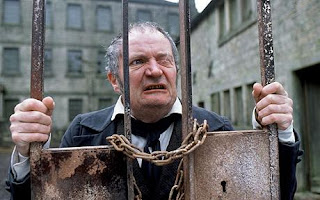
I'm about a quarter of the way through. Nicholas, having left Dotheboys Hall after thrashing the sadistic Squeers (see photo - Jim Broadbent as Squeers in the 2002 film), is now rooming with Newman Noggs and attempting to teach French to the four Kenwig daughters. I've hit pause on it, to read Paleofantasy: What Evolution Really Tells Us About Sex, Diet, and How We Live, by Marlene Zuk. This turned up on the new books shelf at Massey, and while I was the first person in the queue, that also means that I have to get it back by this Friday.

Marlene Zuk is a professor of ecology, evolution, and behaviour at the University of Minnesota, so is well placed to comment on the various popular books recommending dietary and other practices supposedly followed by pre-agricultural hunter/gatherer societies (aka cavemen). Books like The Paleo Diet argue that since the adoption of agriculture about 10,000 years ago, there hasn't been enough time for our bodies to adapt. Or that since we were hunter/gatherers for much longer than we've been farmers, we must be 'better adapted' to the former lifestyle.

Zuk cheerfully points out that this is not true - adaptations can appear and become widespread in a very short space of time. A non-human example she cites is of male crickets in Hawaii who no longer make noise with their wings, an adaptation that became widespread in about 20 cricket generations - about 5 years! She also repeatedly points out that we have very little knowledge of how early humans actually lived; and that there would have been a wide variation in early societies as there are in modern societies (including modern hunter/gatherer societies).

I've finished the section on diet, and have just started the chapter on exercise. I look forward to finding out why I shouldn't worry too much because I can't remember the last time I hunted down a wildebeest or fled a snarling sabre-tooth.


Saturday, August 10, 2013

Pacific explorers, odd beliefs, and cycling

I didn't blog at all in July? Well, I assure you I was visiting libraries and reading. However the urge to go back and fill in the gaps is death for any kind of diarying, so most of what I read and borrowed in July will now stay between me and my reading notebook.

I belong to a book circle, which is a WEA book discussion scheme one. I've belonged to it for - at least 10 years? Probably 15? Or more. Ages anyway. The quest for origins: who first discovered and settled New Zealand and the Pacific Islands, by K.R. Howe is our current book, and I very much suspect I will be one of the few people in the group who will have finished it. I started it early because a friend had warned me it was a slow read. Luckily, for me it wasn't.

Howe, who is a History professor at Massey's Albany campus, was approached by Penguin to write the book after a couple of his responses to various breathless media reports about 'shocking new revelations  about the discovery of New Zealand'. The book covers the history of (European) ideas about where Pacific Islanders came from, and most interestingly, why the assumptions behind these ideas, and often the prejudices that these ideas served. One of the main ideas behind several older theories was the idea that cultures didn't change unless under the influence of another culture - usually a superior one. Gosh, I wonder what sort of cultures they had in mind? Howe argues that this sort of thinking is often behind a lot of the more odd-ball ideas that come up today, whereby pre-Tasman visits to NZ are claimed for the Spanish, the Chinese, the Portuguese, the Celts, and for all I know, probably the Inuit!

It's quite an academic book, however I appreciate that. If I'm reading non-fiction I want the nerdy stuff like indexes, bibliographies, and footnotes. In fact, my main complaint about this book is there is a quirky little comment about people once believing people would melt if they crossed the equator. Reference needed, as Wikipedia would say.

The book I'm currently reading is from Massey Library, and is Cycle space: architecture and urban design in the age of the bicycle, by Steven Fleming. One of the things I appreciate about Palmie is its cycle friendliness. (Well sort of. We still get spluttery letters in the paper complaining about the audacity of cyclists actually using the roads.) We have wide flat roads, and about a year ago the council tarsealed the bridle track that runs along the Manawatu River, which means that for most of my bike commute home I'm cycling along gazing at the river and the meadow, counting how many dogs are out walking with their owners, and in no danger of being hit by a car. Thanks PNCC! Tho' again there were spluttery letters in the paper about bikes being allowed on walkers' rightful territory. Sigh...

Back to Fleming's book! There are vignettes of various cycling cities (Amsterdam, Copenhagen, Sydney, etc), but the bulk of the book is about what the subtitle says. Because he references a lot of buildings and objects and designers its the sort of book that I read wanting Google beside me. Besides the architecture and design side, he also reflects on the class aspects of cars and cycling, and the various romantic cliches of cycling. He's unashamedly pro-cycling and keeps asking why you'd walk when you can bike. Must be rubbing off on me. I had to walk across campus the other day and thought how much quicker (and more fun) it would be if I could just hop on a bike.


Wednesday, June 26, 2013

Blog hijack!

We interrupt this irregularly scheduled blog to bring you holidays news from Vancouver. I make this point in case this blog becomes a international and long standing success and future readers wonder what on earth happened at this point.

Monday, our first full day here I woke at about 7 and decided to go walking in search of a wool shop and a cookbook shop I'd heard about. The day was overcast and rain was forecast so I grabbed an umbrella. I walked ages (Vancouver street numbers reach the thousands) and...the wool shop was closed. By that time its name - Wet Coast Wools - was prophetic and it was belting down. I took refuge in a cafe with tea and a cinnamon roll. Then I walked ages back looking for Barbara Jo's books for cooks...which was closed! Back across a bridge and again it started pouring. There was supposed to be a mall nearby and while I'm not find of malls, I was pretty sick of the rain. Couldn't spot it, so headed for the Vancouver Public library. Shelter and a place to sit down! I'd been walking for about 3 hours with only a cinnamon roll to sustain me.

By the time David arrived (btw, maps rule, GPS' drool) it was more like 6 hours with only a cinnamon roll to sustain me, so after about another hour(!) of walking we decided to try the place selling poutine we'd seen Sunday night.
Poutine is something else. Like chips? Like gravy? Like cheese? (think of a solid rubbery non melting cheese like halloumi). Put them together, and that is poutine. The place we went to obviously felt this wasn't enough and added onions, green peppers, mushrooms, bacon, and pepperoni (me) and smoked meat (David). It's the sort of thing polar explorers would eat to stop the flesh melting off their bones.

Tuesday, after all the walking (we went out bookshop chasing in the evening - luckily, they were open), I didn't wake until late. More walking! I'd located a wool shop (or yarn store) in gastown called Wool is Not Enough, we walked round and about and all over downtown and eventually caught a bus out to the University of British Columbia.

This was beautiful. I loved my time at Victoria, and Massey is a good place to work and a pretty campus, but UBC is huge! So much green, forest, gardens (tho' we didn't get to the gardens sadly) and - the Museum of Anthropology. I'd been hearing about MOA right from when I first started reading about Vancouver. It has an amazing collection of Musqueam and First Nations art, house posts, totem poles, carvings. Plus the multiversity galleries, which have objects from all around the world (although I don't remember Australia and NZ). They have an online catalogue - go and look at it! Particularly look up 'house dishes' and 'last supper of lucifer'. I was going to post photos but uploading was so slow I thought the computer elves were assembling them pixel by pixel.

We were there in the evening, a sunny evening. Peaceful and awe-inspiring. Also sobering. One of the last things I looked at was a document signed late last century by various First Nation leaders of the North-West Coast (re)asserting their sovereignty. As in New Zealand, treaties with aboriginal peoples have a fairly sorry history.